New York City’s zoning codes establish rules and restrictions for both the permissible use and physical bulk of buildings, dictated specifically to each zoning district. Use regulations determine appropriate activities for a structure, defining areas for residential, commercial, manufacturing, or community facility functions. Simultaneously, bulk regulations govern the shape and size of the development, addressing specifics like building height, floor area, setbacks, and density (number of apartments in a residential building). A property owner can request a change to what zoning district governs their property to a process called Rezoning.
In New York City, property owners or any individual can request the rezoning of a property or area through a formal application known as the Uniform Land Use Review Procedure (ULURP). The application’s progression and ultimate approval are discretionary, involving reviews and votes from the local Community Board, the Borough President, the City Planning Commission.
I am Jorge Fontan, an architect in New York and owner of Vinculum Architecture, a Manhattan-based architecture firm. At Vinculum we work on a variety of project types, including applications for Rezonings in New York. In this article, I will explain more about the NYC Rezoning Process, outline general information regarding the application procedure, steps, and general requirements.
What is Rezoning
Rezoning is the process of changing the zoning district for a given property or area by making an amendment to the city zoning maps and or zoning text amendments. In NYC, this application is reviewed by the City Planning Commission and City Council.
The reason to request a rezoning is to change the applicable regulations on your property. This change can be to alter the potential use of the property or to change the applicable bulk regulations.
Upzoning: Upzoning amends a property’s zoning designation to increase its development potential—specifically the allowable bulk or density—while generally maintaining the existing use type. One example would be rezoning a parcel from an R6 to an R8 residential district. Although both are residential zones, the R8 classification permits a significantly larger structure to be constructed on the site.
Rezoning: Rezoning a property allows owners to change its permitted use. A common example involves converting a Manufacturing (M) District to a Residential (R) District, such as changing an M1-2 designation to an R6A. Alternatively, a commercial overlay can be added to an existing residential district. For instance, adding a C1-2 overlay to an R5 Zoning District permits retail development while preserving the primary residential designation.
Below is an example of a NEw York City Zoning MAP. You can see the level of complexity and variation in zoning districts.
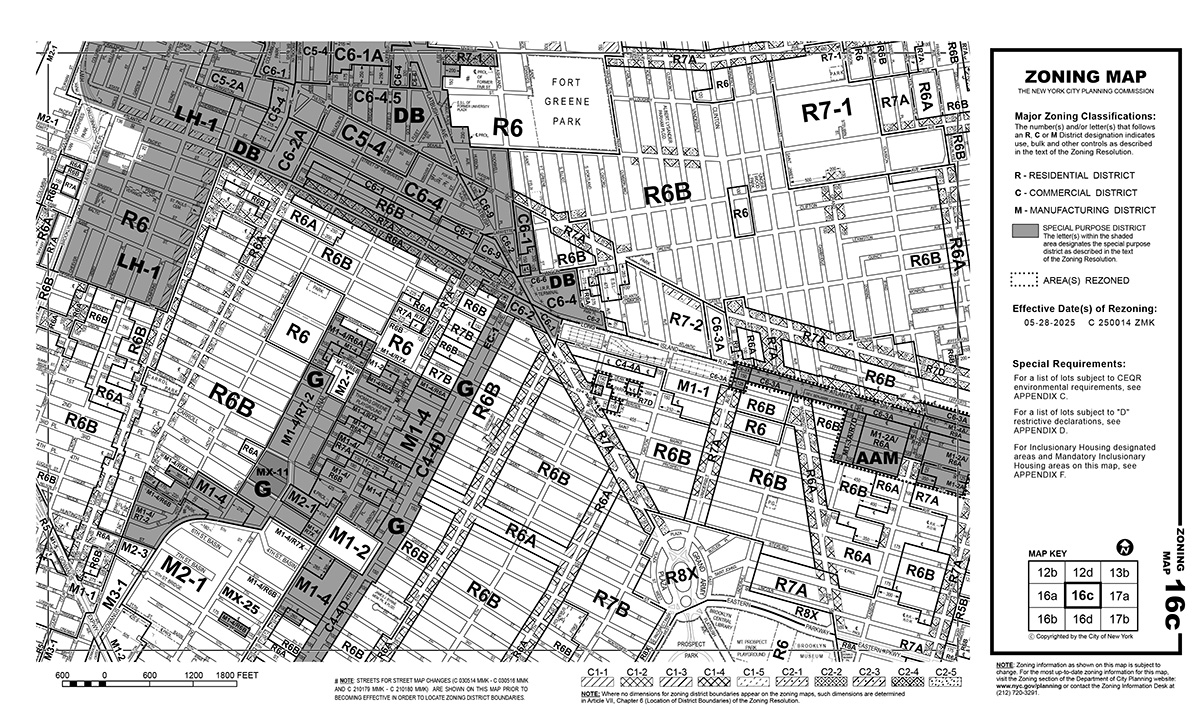
NYC Zoning Map Example
How to Get a Rezoning in NYC
A rezoning application in New York City is a formal public review process subject to the Uniform Land Use Review Procedure (ULURP) as mandated by the City Charter.
The entire rezoning process—from initial planning, design, and assembling a professional team to the final certification, extensive environmental review (CEQR), and the structured ULURP timeline itself—typically spans one and a half to two years and represents a significant financial investment. Below is a brief outline of the steps involved in the process:
- Pre-Application Planning and Team Assembly: This initial phase involves hiring a specialized team (architect, attorney, environmental consultant) and developing a cohesive proposal. This stage often takes several months working with the Department of City Planning (DCP) before the formal clock begins.
- Environmental Review (CEQR): A parallel, often time-consuming process where the project’s potential environmental impacts (e.g., traffic, shadows, air quality) are assessed. A draft Environmental Impact Statement (DEIS) or a determination of no significant impact must be completed before the application can be certified as complete.
- Pre-Certification Notice: A required 30-day notice period before formal certification, informing the affected local Community Board and Borough President of the impending application.
- Certification (The start of the ULURP Clock): Once the DCP certifies the application is complete and ready for public review, the formal, time-bound ULURP process begins, which has a duration of approximately seven months.
- ULURP Review Phases: This structured public review includes advisory recommendations from the Community Board (60 days) and the Borough President (30 days), followed by binding votes by the City Planning Commission (60 days) and the City Council (50 days).
Below is a more detailed outline of the steps and actions involved in a rezoning application.
- Assemble the Project Team (Start with an Architect and Land Use Attorney)
- Team Conducts an Analysis and Determines the Proposed Zoning
- Create a Design Proposal
- Informational Interest Meeting DCP
- City Environmental Quality Review (CEQR)
- Precertification Notice
- Certification
- ULURP Clock Begins
- Community Board
- Borough President
- City Planning Commission
- City Council
- Mayors Office
Rezoning Project Team
- Architect: The architect translates the development goals into a proposed building design and ensures the plans adhere to complex NYC zoning regulations.
- Environmental Consultant: This expert conducts required environmental studies as part of the City Environmental Quality Review (CEQR) process, assessing the project’s impact on issues like traffic, air quality, and open space, which can take several months or longer to complete.
- Zoning Attorney: The attorney provides legal counsel on land use law, manages the application process, represents the applicant during public hearings, and negotiates with city agencies, community stakeholders, and local politicians such as Council Members and the Borough President’s office. The attorney working on a rezoning in NYC must be a registered lobbyist.
This team prepares a comprehensive application, conducts detailed studies, and develops a design proposal for the property. The process begins with a crucial pre-application phase involving informational meetings with the Department of City Planning (DCP) before the formal ULURP process begins.
The first and most critical step is to consult with an architect who is not only familiar with the New York City Zoning Resolution but is also especially experienced in navigating the intricate rezoning and ULURP processes from initial concept to final approval. At our office we dedicate a great deal of time to understanding the intricacies on New York City Zoning and working with local agencies and officials to understand the types of rezoning that are likely to get approved.
Determining the Proposed Zoning District(s)
As an architect working on rezonings in New York City, the most critical piece of advice I offer clients is the necessity of making a reasonable choice when selecting which zoning district you want to propose. We work closely with our clients to discuss the options and offer suggestions on what zoning districts make the most sense for the subject property.
While property owners naturally aim to maximize their development potential and increase property value by pursuing the highest-density zoning districts available, proposing a classification that is significantly out of scale with the surrounding neighborhood can be detrimental to the project’s success. Failing to respect the area’s established character often results in strong opposition from the community, Department of City Planning, and local politicians.
A successful application must start with realistic expectations. The goal is to propose zoning districts and building designs that “make sense” in their specific context and are viable candidates for approval through the public Uniform Land Use Review Procedure (ULURP) process.
Creating a Design Proposal
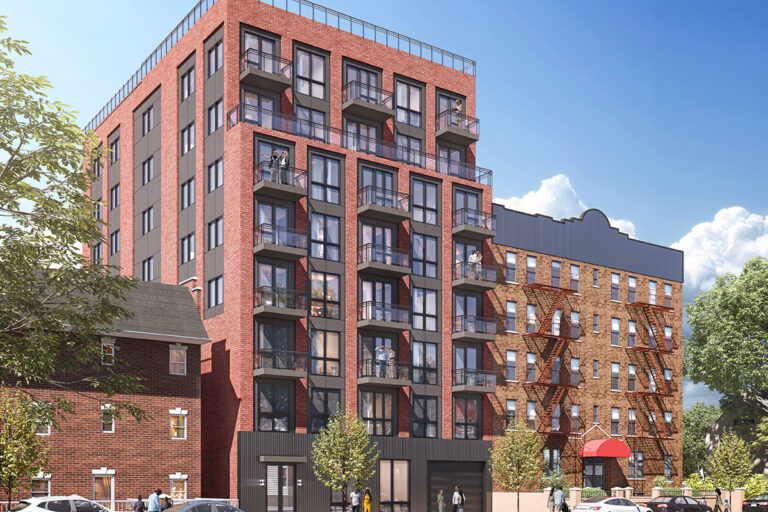
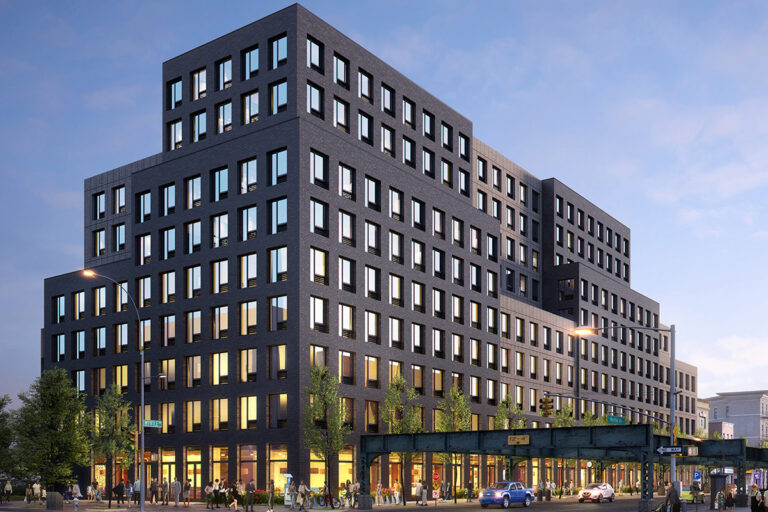
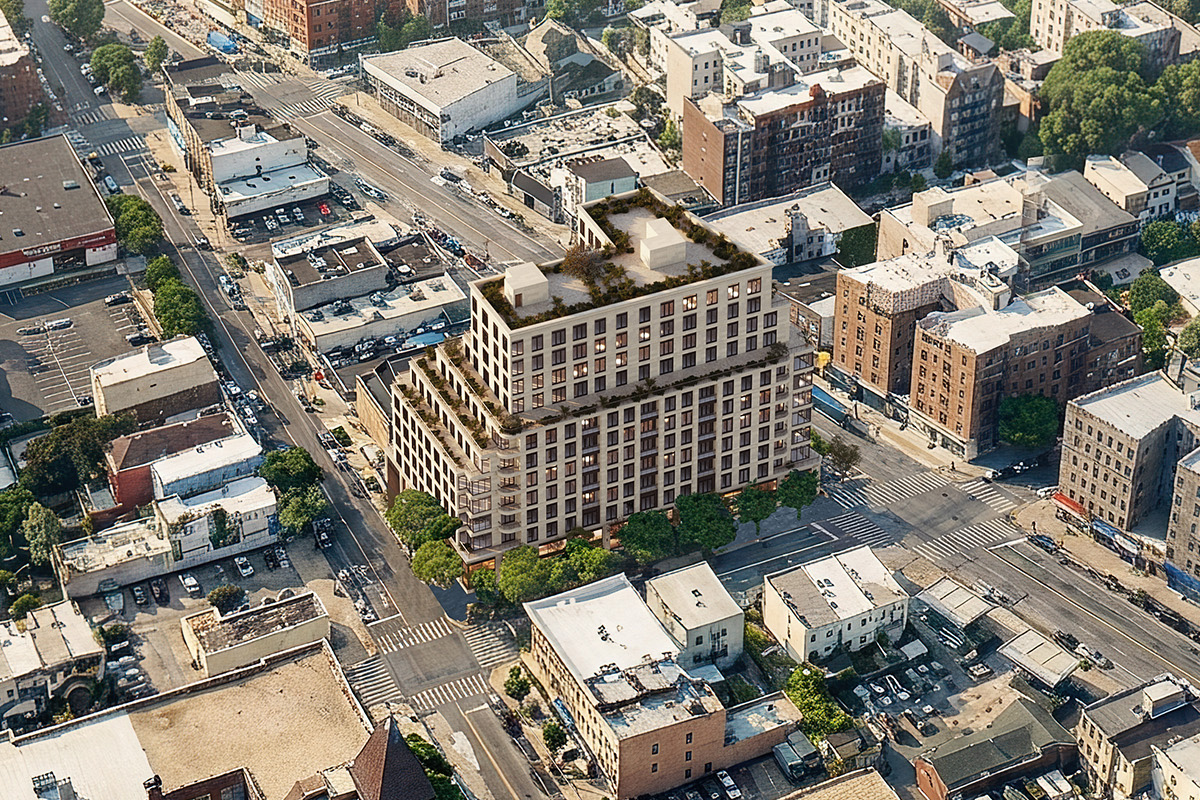
When initiating a rezoning proposal in New York City, a comprehensive package of materials—including architectural plans, 3D renderings, a detailed zoning analysis, and various supporting documents—must be prepared and submitted to all involved review entities, starting with the Department of City Planning (DCP) during the crucial pre-application phase.
As the project architect, the preparation of this entire submission falls under our scope of work. We work collaboratively with our clients to design buildings that not only fulfill their programmatic needs but also present a compelling urban design argument that is likely to be well-received by the reviewing bodies (including the local Community Board, the Borough President, and the City Planning Commission).
The pre-application period is vital for early engagement. During initial meetings, DCP staff provide input and suggestions regarding site planning, massing strategies, and the building’s overall design prior to the formal Uniform Land Use Review Procedure (ULURP) timeline.
Informational Interest Meeting DCP (Pre-Cert)
The Department of City Planning (DCP) must formally certify a rezoning application as complete before the mandatory Uniform Land Use Review Procedure (ULURP) clock can begin.
The pre-certification process generally begins with an initial “Informational Interest Meeting” or scoping session, where the applicant’s team provides a preliminary presentation to DCP staff. During this meeting, we review the proposed zoning district changes and articulate the land use rationale that supports our selection.
This vital pre-application phase typically involves a significant amount of feedback and comments from the DCP, potentially necessitating multiple revisions to the proposal. The process is highly iterative, as the DCP guides the application toward a state where it is both technically sound and contextually appropriate for formal public review.
City Environmental Quality Review (CEQR)
The City Environmental Quality Review (CEQR) is New York City’s process for complying with the State Environmental Quality Review Act (SEQRA). It requires city agencies to assess potential environmental impacts of proposed discretionary actions (e.g., land use changes, zoning amendments) before granting approval.
The process starts with an Environmental Assessment Statement (EAS) to determine if an action may have significant adverse environmental impacts. If not, a Negative Declaration (Neg Dec) is issued. If impacts are likely, a detailed Environmental Impact Statement (EIS) is drafted, covering issues like traffic, air quality, and historic resources, guided by the CEQR Technical Manual.
An environmental consultant will work on this portion of the project.
DCP Certification
The Department of City Planning (DCP) must formally certify a rezoning application as complete before the mandatory Uniform Land Use Review Procedure (ULURP) clock can begin. This marks the completion of the pre-application phase. The ULURP process will not begin without Certification from DCP.
Uniform Land Use Review Process (ULURP)
Once an application is certified by The Department of City Planning, the formal Uniform Land Use Review Procedure (ULURP) officially begins, starting a strict statutory timeline for each phase of public review.
This standardized process ensures predictable, consistent review periods across various city agencies and local governing bodies. The entire public review timeline is designed to take a minimum of approximately seven months (or around 200 days) from certification to the final action.
Community Board
The Uniform Land Use Review Procedure (ULURP) mandates a public hearing process at the affected local Community Board for any rezoning proposal. This advisory review phase is slated for a maximum of sixty days.
Upon completion of their hearings and review, the Community Board submits a written recommendation. This vote is strictly advisory and non-binding, meaning their decision cannot guarantee the denial or approval of the proposed rezoning. Their input serves to inform subsequent decision-making bodies, such as the Borough President, the City Planning Commission, and the City Council, but holds no definitive legal power in the final outcome.
To provide specific context on the weight of the Community Board’s vote: we recently secured approval for a rezoning project in Brooklyn where the local Community Board voted against our proposal. However, the application was ultimately passed because both the City Planning Commission (CPC) and the New York City Council voted in our favor. You can read more about navigating this specific scenario and attaining final approvals in our detailed article, Our Recently Approved Rezoning in Brooklyn.
Borough President
after completing the community board review phase of (ULURP), the application moves to the Borough President for consideration. The Borough President has a strict 30-day window to review the proposed rezoning and issue a written recommendation to the City Planning Commission (CPC).
Like the Community Board’s input, the Borough President’s recommendation is entirely advisory and non-binding. This phase provides a broader, borough-wide planning perspective, contrasting with the local focus of the community board review and assessing the project’s consistency with strategic borough plans. While the vote itself is not final it can have significant influence on the parties with a binding vote.
City Planning Commission (CPC)
After advisory reviews by the local Community Board and Borough President, the application moves to the City Planning Commission (CPC) stage, which has a 60-day time limit. During this time, DCP staff present the proposal, and the Commission holds a public hearing for testimony. The CPC then votes to approve, approve with modifications, or disapprove the rezoning. A simple majority of at least seven affirmative votes is typically required. A CPC disapproval usually terminates the entire ULURP process. If approved, the application proceeds to the City Council for its review and final decision.
City Council
Following the City Planning Commission (CPC) approval, a rezoning application enters the final 50-day review period by the New York City Council. The application is first reviewed by the Council’s Subcommittee on Zoning and Franchises and the Land Use Committee, where additional public hearings are held for testimony. The Council then casts a binding vote, requiring a simple majority to approve the action.
A key political dynamic is “member deference,” an informal practice where the entire Council typically defers to the local member’s position on projects within their district, making their vote a decisive factor. The Council can approve, disapprove, or modify the proposal. Any modifications are sent back to the CPC for a 15-day review to ensure no new environmental issues arise.
If City Council Approved the rezoning the proposal passes and the zoning is officially modified.
Affordable Housing Appeals Board
New York City has established a process to appeal a denied Uniform Land Use Review Procedure application, provided the application facilitates the creation of affordable housing. This new mechanism, created by a November 2025 charter amendment, specifically applies when the City Council disapproves a project located within a single borough.
Instead of the traditional mayoral veto process for these specific cases, the applicant or two board members may request review by the new Affordable Housing Appeals Board. The Board consists of three officials: the Mayor, the Speaker of the City Council, and the applicable Borough President. A decision to reverse the City Council’s denial requires a two-thirds vote (agreement from two of the three members). This process aims to balance local concerns with citywide housing needs.
To learn more about the mechanics and criteria for this appeal process, you can review another article we wrote on the Affordable Housing Appeals Board.
Rezoning Process in NYC
Rezoning in New York City is a notoriously lengthy, complicated, and costly process that results in significant changes to the urban landscape. For property owners and private developers, a successful rezoning can dramatically increase land value by permitting larger buildings or more profitable uses. For communities, these proposals often bring benefits like new affordable housing units through Mandatory Inclusionary Housing (MIH), essential infrastructure upgrades, job creation, and added housing stock.
However, the process is a delicate balancing act, often sparking intense debate over concerns about displacement, gentrification, and the potential loss of neighborhood character. Achieving success requires meticulous planning, substantial investment, and careful navigation through the process.
Thank You for Reading Our Article on The New York City Rezoning Process.
I hope this was helpful. If you would like to speak with an architect about a potential project, please get in touch with us directly at Vinculum Architecture.
Request a Consultation With Vinculum Architecture
This post was written by Jorge Fontan AIA a Registered Architect and owner of New York City based architecture firm Vinculum Architecture. Jorge Fontan has earned 3 degrees in the study of architecture including two degrees from the City University of New York and a Masters Degree in Advanced Architectural Design from Columbia University. Jorge has a background in construction and has been practicing architecture for 20 years where he has designed renovations and new developments of various building types.