The New York City Zoning Resolution outlines specific restrictions on land use and building bulk (size and shape) across the city. Because these regulations are often complex and restrictive, there is a mechanism for property owners facing unique physical constraints to seek relief. A qualifying property development may apply for an exception to one or more specific zoning regulations, these exceptions are known as a zoning variance. For example if a property requires additional floor area beyond that allowed by zoning it may be possible to attain a Floor Area Variance.
In New York City, a zoning variance is a discretionary action granted by the Board of Standards and Appeals (BSA) that allows a property owner to surpass certain specific Zoning Resolution requirements. This process is typically used when unique physical conditions create an unnecessary hardship, preventing “as-of-right” development. For example, a Floor Area variance enables a developer to exceed the maximum permitted square footage, resulting in a larger building than the standard district regulations would otherwise allow.
I am Jorge Fontan, an architect in New York and owner of Vinculum Architecture, a Manhattan-based architecture firm. At Vinculum, we work on a variety of project types, from property and zoning analysis to complete building designs for new developments. In this article, I will review a zoning variance for additional floor area that we received for a property in Brooklyn.
What is a Zoning Variance
A zoning variance is an approval granted by the Board of Standards and Appeals, providing a specific exception from a specified zoning regulation. This authorization targets particular sections of the zoning resolution, and the limits of the variance are clearly defined, outlining the extent of permitted noncompliance.
While you can request a variance for any Zoning Resolution requirement, the Board of Standards and Appeals (BSA) grants them only for specific, narrowly defined hardships. A variance is not a blanket authorization; it provides relief only for the items requested and does not give a developer “free reign” to bypass other applicable regulations.
As an architect, I have successfully obtained numerous zoning variances from the Board of Standards and Appeals (BSA) over the years. This article focuses on one specific approval: a Floor Area variance. New York City zoning establishes a Floor Area Ratio (FAR) to limit a building’s maximum square footage, but in certain cases, the BSA can grant a variance to exceed these limits.
You can find a deeper explanation of the process in my related article on NYC Zoning Variances.
Requirements for a Variance
To qualify for a BSA Zoning Variance, an applicant must satisfy five specific “findings” required by the NYC Zoning Resolution. A variance is not granted simply to bypass development limits; it requires proving a legitimate hardship based on the following criteria:
- A. Unique Physical Condition: The lot must have unusual physical features (e.g., excessive narrowness/shallowness, unusual topography) causing practical difficulties with zoning adherence.
- B. No Reasonable Possibility of Development: The hardship must prevent development that strictly adheres to the Zoning Resolution and yields a reasonable return; the variance is essential to achieve this return.
- C. Not Alter the Character of the Neighborhood: The proposed development, if the variance is granted, cannot negatively impact or change the neighborhood’s essential character.
- D. Difficulties and Hardship are Not Created by the Owner: The owner applying for the variance must not have created the unique conditions and practical hardship themselves.
- E. Minimum Variance Necessary: The variance request must be the minimum needed to alleviate the unique condition and hardship.
Unlike “As-of-Right” developments, which only require standard building permit filings, variances are discretionary actions. This means the Board of Standards and Appeals (BSA) must formally review your application and vote on whether it meets the legal merits for a hardship. The Board maintains full authority to deny any proposal, and approvals are granted strictly at their discretion.
Our Approved Zoning Variance
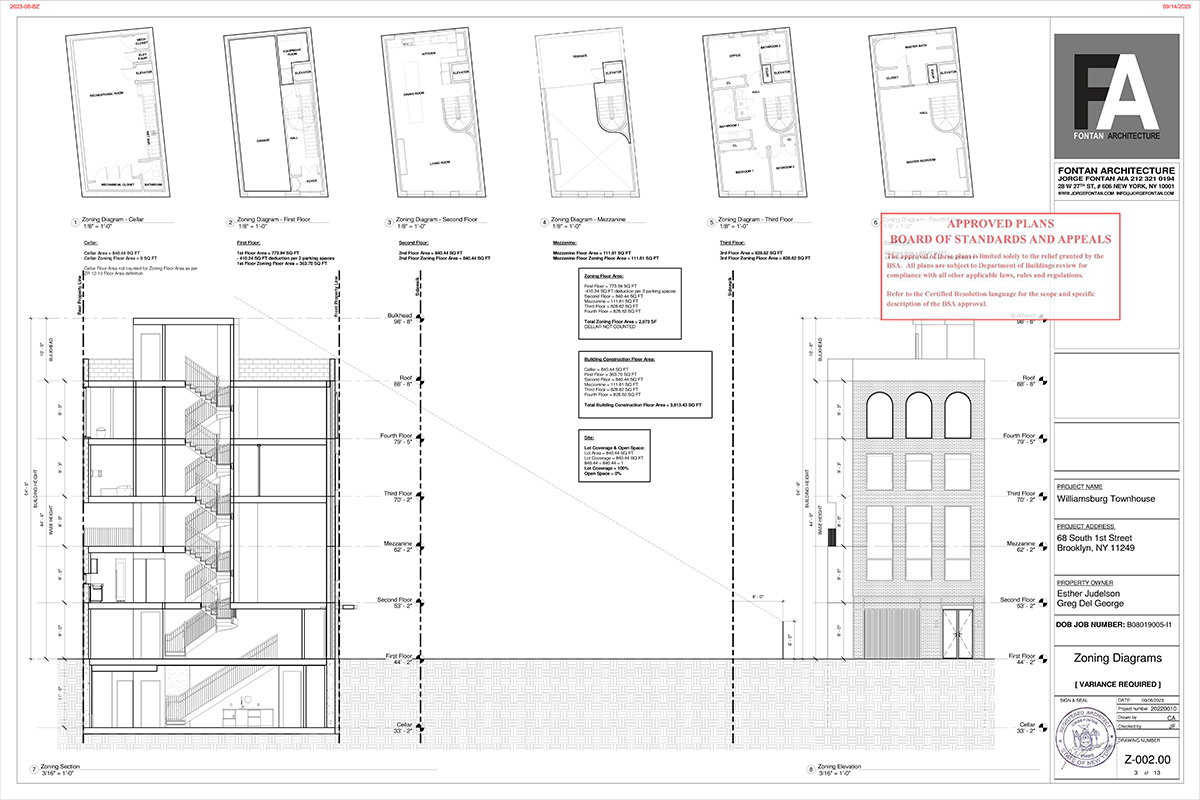
Our clients purchased an empty lot in Williamsburg Brooklyn where they wanted to build a new modern townhouse. Our team recently navigated these complexities for a client who purchased a vacant lot with a restrictive Floor Area Ratio (FAR) of 2.2. On a lot smaller than 1,000 square feet, the “as-of-right” allowance would have capped the home at just around 1,800 square feet—far below the size of existing townhomes in their local vicinity.
To secure relief, we pursued a BSA Zoning Variance by demonstrating a unique physical hardship and provided the following:
- Comparative Neighborhood Analysis: We proved that an 1,800-square-foot structure would be out of character with surrounding homes, which often exceed that size, establishing that the current zoning created an unnecessary hardship.
- Unique Conditions: We identified how few neighboring lots shared this specific physical constraint to ensure the request met the “uniqueness” finding.
- Design-Based Advocacy: We presented side-by-side architectural comparisons, illustrating that the proposed variance was the minimum relief necessary to build a viable, modern residence.
After a comprehensive review process—including a presentation to the local community board—the BSA approved an increase in FAR from 2.2 to 3.54. This successful outcome allows our clients to build a townhouse that meets a more realistic standard while remaining harmoniously integrated into the Williamsburg streetscape.
Getting a Variance Approved in NYC
When navigating the complexities of zoning variances, the most critical factor for a successful application that I can share with you is proposing a development with realistic expectations. The Board of Standards and Appeals (BSA) has a “minimum variance” rule, meaning any request must be the absolute least amount of relief required to alleviate a hardship.
With a deep understanding of NYC Zoning and extensive experience with the BSA, our team begins every project by identifying the practical constraints of a site. We analyze what can realistically be approved before filing, as requesting excessive relief often leads to costly delays and ultimate denial. By aligning your goals with the BSA’s rigorous findings, we ensure you don’t waste time and capital on a proposal that lacks a viable path to approval.
If you are considering a development project, contact us at Vinculum Architecture for a consultation. We can help you determine the feasibility of your project, provide full design services, and guide you through the intricate process of obtaining city approvals to bring your vision to life. Succeeding in the NYC real estate market requires a strategic approach to the city’s complex regulatory environment. We offer both vision and expert architectural services.
Thank You for Reading Our Article on Our Approved Floor Area Variance
I hope this was helpful. If you would like to speak with an architect about a potential project, please get in touch with us directly at Vinculum Architecture.
Request a Consultation With Vinculum Architecture
This post was written by Jorge Fontan AIA a Registered Architect and owner of New York City based architecture firm Vinculum Architecture. Jorge Fontan has earned 3 degrees in the study of architecture including two degrees from the City University of New York and a Masters Degree in Advanced Architectural Design from Columbia University. Jorge has a background in construction and has been practicing architecture for 20 years where he has designed renovations and new developments of various building types.