The New York City Zoning Resolution comprehensively outlines specific restrictions on land use and building bulk (size and shape) across the five boroughs. Because these regulations are often complex and restrictive, the system provides a mechanism for property owners facing unique physical constraints to seek relief. A qualifying property development may apply for an exception to one or more specific zoning regulations, these exceptions are known as a zoning variance.
A zoning variance in New York City is a special discretionary action granted by the Board of Standards and Appeals (BSA) that allows a property owner to use or develop a property in a manner the does not fully comply with all of the applicable zoning regulations.
I am Jorge Fontan, an architect in New York and owner of Vinculum Architecture, a Manhattan-based firm. At Vinculum we work on variety of project types, including complex applications that require a zoning variance. In this article, I will explain more about what a zoning variance is, outline general information regarding the application process, and illustrate these concepts using examples from our previously approved projects.
Zoning Variances
Zoning variances are highly specific legal instruments that grant targeted relief from one or more specific sections of the NYC Zoning Resolution. It is crucial to understand that receiving a variance is not a blanket approval to ignore the entire zoning code or build whatever one desires. The application process demands precision: when applying for a zoning variance our firm must explicitly state the exact regulation sections we wish to modify and clearly define the precise extent of the requested variance. This ensures strict control over the development even with an approved variance. For instance, if we successfully apply for a floor area variance, our project is legally restricted to the exact square footage and dimensional limitations approved by the Board of Standards and Appeals (BSA), offering highly specific relief.
How to Get a Zoning Variance in NYC
A zoning Variance is an appeal to a disapproval from the Department of Buildings. Before you can apply for a Variance you must first file plans with the department of buildings and receive an objection and official disapproval on your application.
The New York City Zoning Resolution outlines the requirements and findings one must present and prove in order to obtain a zoning Variance a summery of the findings are as follows:
A. Unique Physical Condition: The subject zoning lot must have a unique physical conditions such as being excessively narrow or shallow, having unusual topographic or physical conditions resulting in practical difficulties arise in adhering to the zoning Resolution.
B. No Reasonable Possibility of Development: The unique physical condition must cause a hardship that does not allow for the possibility of development in strict adherence to the Zoning Resolution with a reasonable return. The Variance would be therefore necessary for the owner to achieve a reasonable return.
C. Not Alter the Character of the Neighborhood: If the variance is granted the proposed development cannot alter the essential character of the neighborhood or have a negative impact on neighboring properties.
D. Difficulties and Hardship are Not Created by the Owner: The unique conditions and practical hardship cannot have been created by the owner applying for the Zoning Variance.
E. Minimum Variance Necessary: The extent of the variance request must be for the minimum variance necessary to achieve relief from the unique condition and hardship presented.
Discretionary Actions
Obtaining a zoning variance in New York City is a complex and highly discretionary process, fundamentally different from standard “as-of-right” development. You can apply for a variance to deviate from nearly any provision of the NYC Zoning Resolution, but approval is never guaranteed. A variance is a discretionary action, meaning the Board of Standards and Appeals (BSA) exercises judgment in granting approval; the City of New York does not owe you a variance. You are not entitled to a Zoning Variance.
Unlike as-of-right applications, which are approved if they meet all objective zoning criteria, variance applications can be denied entirely at the discretion of the five-member BSA board. The Board will vote and determine if they agree with the proposal.
It is also important to know that if you apply for a variance in accordance with the “E Finding” for the minimum variance necessary the Board can ask you to reduce the extent of your request and approve a variance to a lesser degree than proposed.
Types of Zoning Variances
A wide range of site-specific challenges may require applying for a zoning variance from the Board of Standards and Appeals (BSA). Below, we review a few of the common scenarios and types of variances for which property owners typically seek relief.
Use Variance
A use variance is a request to permit a use of land that is expressly prohibited by the underlying zoning regulations of a specific district. For example, if you own a property in a Manufacturing (M) District—where new residences are generally prohibited (with some exceptions) —and wish to construct a residential building, you would need to apply for a use variance. You can pursue a residential development in a Manufacturing zoning District if you obtain approval for a Zoning Use Variance from the Board of Standards and Appeals (BSA).
Floor Area Variance (FAR Variance)
If your property is an unusually small zoning lot compared to others in the surrounding neighborhood, you may be eligible for a Floor Area Variance. This variance can grant you additional buildable floor area, allowing you to increase the total square footage of your potential new development beyond what standard zoning typically permits.
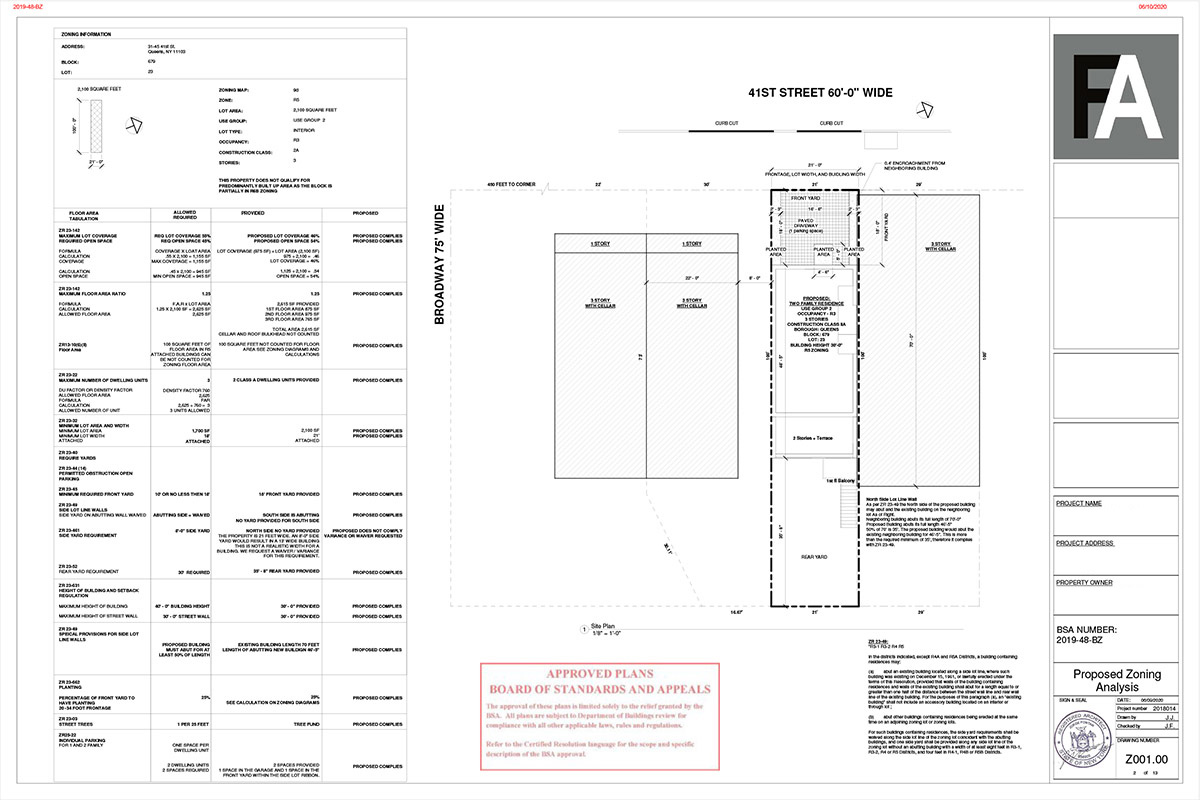
We can point to a strong example from our portfolio of past approved projects: we successfully attained a Zoning Variance to develop a property in Williamsburg with an additional one thousand square feet above the standard allowable buildable area. This outcome was achieved through careful presentation of evidence to the Board of Standards and Appeals (BSA) to satisfy the required “Five Findings” for a variance. Considering they were only able to build around two thousand square feet on their very small lot, adding another thousand square feet through a variance greatly improved the property use.
Yard Variance
Our team has successfully obtained yard variances from the Board of Standards and Appeals (BSA) for properties across New York City that presented challenging dimensions, such as those that are exceptionally shallow or narrow lots.
Zoning regulations mandate specific minimum yard requirements, which inherently limit the maximum buildable area on a given property. A granted yard variance can provide necessary relief by either reducing these requirements or waiving them completely. We have experience securing approvals using both options, depending on the project’s specific needs and the BSA’s determination.
Obtaining a Zoning Variance in NYC
Ultimately, the key to successfully obtaining a Zoning Variance in New York City is employing a strategic approach. Success depends entirely on developing a plan that finds the precise balance between the property owner’s needs, the rigorous legal requirements of the variance process (specifically the “Five Findings”), and the discretionary expectations of the Board of Standards and Appeals (BSA). We have spent many years working on Variances in New York and can tell you that the right strategy is the difference between an approval and denial.
Thank You for Reading Our Article on What are Zoning Variances in New York City.
I hope this was helpful. If you would like to speak with an architect about a potential project, please get in touch with us directly at Vinculum Architecture.
Request a Consultation With Vinculum Architecture
This post was written by Jorge Fontan AIA a Registered Architect and owner of New York City based architecture firm Vinculum Architecture. Jorge Fontan has earned 3 degrees in the study of architecture including two degrees from the City University of New York and a Masters Degree in Advanced Architectural Design from Columbia University. Jorge has a background in construction and has been practicing architecture for 20 years where he has designed renovations and new developments of various building types.